
Like our very own tutor Luke, four out of five Aussies don’t trust FB with their data and they have very good reason not to (Rolfe, 2018). Do you?
Times have changed, there was a time when we used ‘Firewall’ for our digital security but now with the introduction of the ‘Cloud’ and social media platforms, we can never be quite sure about our online data security. This uncertainty does not only affect us individuals, but also companies who have set up their business handles on social platforms. Data frequently travels unprotected through social media channels & considering how much information people over share, social media can put data at serious risk of being leaked. Joseph Steinberg, CEO & founder of SecureMySocial, who created a cloud-based system which alerts users in real time if they are posting something inappropriate, says social media can “Provide hackers with information that greatly assists them in breaching organizations” (Johnson, 2016).
How is data leaked?
‘Personally, Identifiable Information’ (PII) is information which is used to differentiate or trace an individual’s identity either alone or in combination with other public information that is linked to a specific individual. The growth in identity theft, a.k.a, leaked data has given rise to concerns regarding unauthorized disclosure of PII, and who is to blame? Undoubtedly social networks (who are first party servers) who sell user personal information to third-parties (Krishnamurthy & Wills, 2010).
There has been an increase in the use of third party servers who curate content and advertisements for web pages belonging to first-party servers. Some of these third-party servers are aggregators who track and aggregate user viewing habits across different first-party servers often via tracking cookies. Third-party tracking servers are active on a number of popular online social networks and it has been found out that the penetration of the top 10 third-party servers across popular websites has grown from 40% in 2005 to 70% of 2008 (Krishnamurthy & Wills, 2010). We are now in 2018, so one can only imagine the amount of fold increase in these rates.
Facebook’s part when it comes to data leaks is a big one
We all know that Facebook’s core purpose when it started off was to create a platform where people could connect but now, it has ventured into a marketplace for organizations and marketing professionals and also regulators and governments of various nations are using it effectively to their use meaning that there an inclusion of data transfer of billions (Fatima, 2018).
Facebook asks us whether we want to share our information with third party apps that Facebook have tie-ups with and we all oblige. Well, we knowingly or unknowingly put ourselves at great risk.
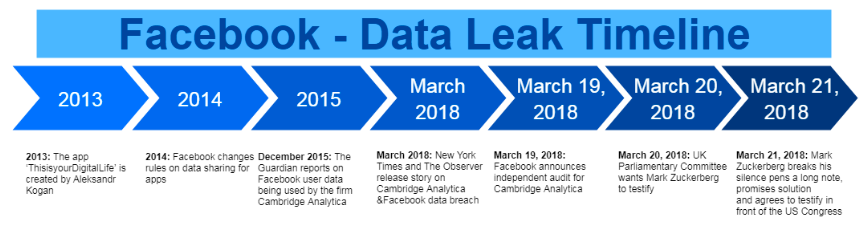
In 2010, Facebook announced the launch of a platform called ‘Open Graph’ to third-party apps which allowed external developers to reach out to Facebook users and seek permission to access a large chunk of their personal data and more importantly to access the data from their friend’s list too. This enabled Aleksandr Kogan, a Cambridge academic, to use his app ‘Thisisyourdigitallife’ to collect personal psychological data from millions of Facebook profiles.
In 2015, Cambridge Analytica a London based political & advertisement data analytics consultant helped Ted Cruz in his political campaign using the data of tens of millions of people from Facebook. In response, Facebook after learning about this, ‘sought’ to ban Kogan’s app and asked Kogan and Cambridge Analytica to remove all the data they had unethically acquired (Meredith, 2018). Recently, it was revealed and confirmed that 87 million people out of which 300,000 were Australian users (Bogle, 2018) were affected in this scandal which was used to influence and manipulate the elections.
How is Facebook making up for this?
Well, they can’t ‘make-up’ for this but it sure is a wake-up call for people. Mark Zuckerberg promises increased transparency with regards to apps and what information we share with them but at least for me, Facebook has lost its credibility and I for one will not be giving access to any app.
Now as promised, here is the link where you can check if your account was affected in the scandal: https://www.facebook.com/help/1873665312923476?ref=shareable
References
Bogle, A. (2018). Facebook privacy breach: How to check right now if Cambridge Analytica got your data. Retrieved from http://www.abc.net.au/news/science/2018-04-10/facebook-tool-check-if-cambridge-analytica-got-your-data/9639572
Fatima, H. (2018). Facebook’s Data Leak: How It Affects Users. Retrieved from https://blog.resellerclub.com/facebooks-data-leak-how-it-affects-users/
Johnson, C. (2016). How Social Media Jeopardizes Data Security. Retrieved from https://www.entrepreneur.com/article/272459
Krishnamurthy, B., & Wills, C. (2010). On the leakage of personally identifiable information via online social networks. ACM SIGCOMM Computer Communication Review, 40(1), 112.
Meredith, S. (2018). Facebook-Cambridge Analytica: A timeline of the data hijacking scandal. Retrieved from https://www.cnbc.com/2018/04/10/facebook-cambridge-analytica-a-timeline-of-the-data-hijacking-scandal.html
Rolfe, J. (2018). ‘Phenomenally low’ trust in Facebook among Aussies even before Cambridge Analytica. Retrieved from https://www.news.com.au/technology/online/social/low-level-of-trust-in-facebook-before-cambridge-analytica-scandal-survey-reveals/news-story/883f39687472f951cabfec71c3e64829
 hashtagonlythetruth.home.blog